
Oskar Dudycz

Pragmatycznie o programowaniu

Let's talk about positions in event stores
2021-10-06 oskar dudyczEvent Sourcing

cover

Discussions about positions can be awkward, to say the least… It is also the case with positions in Event Sourcing. Each event store implementation has its own nomenclature and specificity.

First, let’s find out what is common. Each event store should have two main structures related to the events:

  • append-only log - a structure where all events are added. The name comes from the fact that events can only be added at the end. Thanks to this, we keep the chronology and sequence of events.
  • stream - it is a sequence of events. Those events are correlated by stream identifier, usually representing what facts registered for a specific entity.

Both entities can be considered as FIFO queues (First In, First Out). We always append an event to the end.

Both the append-only log and the individual streams have positions. They represent the specific relative place in the chronology. Using a position, we can walk the events in order of appearance and read history from them.

How are they implemented?

In Marten, the append-only log is one table. The primary key is the sequence field generated by a Postgres sequence with a monotonic number. There may be gaps when an event is not added for some reason (e.g. a conflict or transient error). The events stream is a virtual structure. It is simply a collection of events from the append-only log. It can be selected by the event identifier. The events within the stream have a number called version, which is also a monotonic number, but without gaps. This number can also be used to handle optimistic concurrency. Read more “Optimistic concurrency for pessimistic times” article.

In EventStoreDB, the design is similar.

The append-only log is called the $all stream. It is a specific stream representing all events stored in the database. It is a logical representation of the memory (disk) position where the event is located. The position is monotonic, and may have gaps. To be precise, it is actually composed of two such pointers: a commit and a prepare. They are remainings from when transactions were supported in EventStoreDB (it is to be unified into one number in upcoming versions). For now, if you’re not using transactions, you can treat the commit position as the single relevant one.

The stream version is an automatically incremented number. It is called stream position. Similarly, on its basis, EventStoreDB allows you to use it for optimistic concurrency. Then it is called stream revision.

Interestingly, in EventStoreDB, the physical structures are streams. The $all stream is the secondary structure.

If you subscribe to $all, you will receive events from multiple streams respecting the global order in which they occur. You will need to save the position as the checkpoint of the last processed event. The position can also be used for deduplication and idempotency. You can check if an event was already processed.

It is similar also in Kafka. Although it is not a proper tool for Event Sourcing, it is similar in that the notion of an “append-only log” lies at its core. There, the logical structure is topic, split into a set of physical partitions. The position is named commit offset. This is the entry where the event has been saved on the partition.

Here’s a picture of what it looks like in the Event Store!
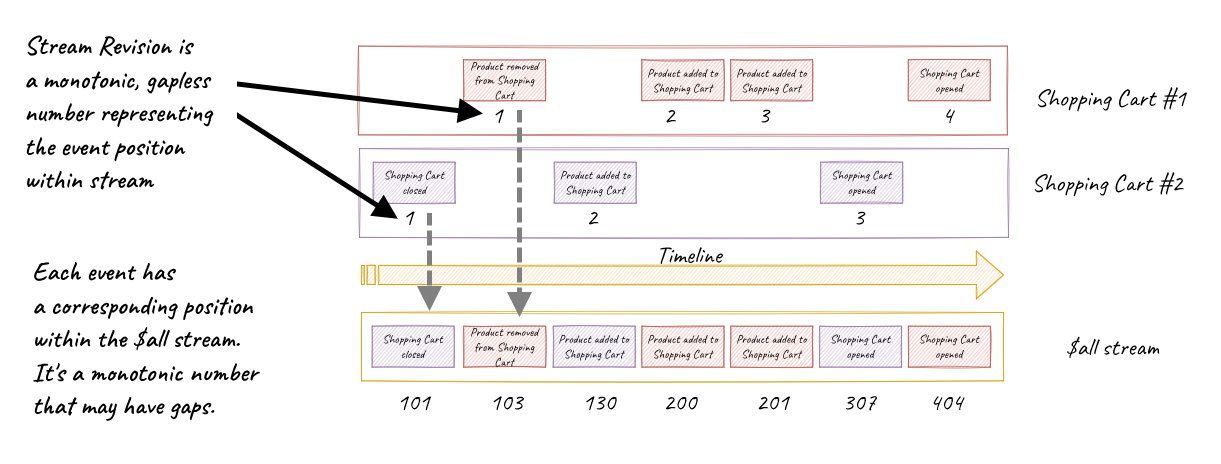
ESDB Positions

As Phil Karlton said: “There are only two hard things in Computer Science: cache invalidation and naming things.” All of the names for the position seems to have their issues, but I hope that this article brought you closer to understanding what they’re all about.

Cheers!

Oskar

p.s. if you liked this article, check also:

👋 If you found this article helpful and want to get notification about the next one, subscribe to Architecture Weekly.

✉️ Join over 11500 subscribers, get the best resources to boost your skills, and stay updated with Software Architecture trends!

Loading...
Event-Driven by Oskar Dudycz

cover

Through my window, I see the result of good plans but poor execution. Opposite my flat, there is a partially completed construction place. Buildings were supposed to be eye-catching Mediterranean style apartments. Delivery date? Two years ago. Actual? More and more unknown.

Some time ago, I heard that using Event Sourcing makes creating Event-Driven Architecture easier. The arguments were correct, that if we’re already publishing events to trigger business workflows, then at some point, we may want to also store events to not lose information. Agreed. However, I also heard that keeping the state as events will simplify things. We’ll have a source of truth with a record of the system behaviour. This will allow, e.g. to confront the results of the operations with the recorded state. I’d agree with that, with one distinction. It’s easier as long as you already know Event Sourcing.

Many people in the DDD community claim that the essential is to properly break down the system into autonomous parts called bounded contexts. Once we have it, the rest is secondary and will sort itself out. For sure.

Many seasoned programmers speak similarly about new technologies. They claim that they can translate past experience into new technologies. That’s true that by analogy, they can catch the big picture quicker. But isn’t it a bold assumption to say that Win.Forms specialist will learn Angular quickly?

The end result may differ a lot from the initial ideas. I saw the plan of those buildings next to me. Now I can see the effects of the execution. Or actually, the lack.

I believe that we should carefully acknowledge not only the point of view of our authorities but also their seating point. If we want to find out how to form a wall, do we ask an architect or a foreman? An architect may know the theory, but the practice is what we’re looking for. On the other hand, if you want to know where to put the wall, you prefer the architect to do measurements. At least if you don’t want to have the roof falling to your head.

After I had torn a ligament in my knee, I went to two qualified orthopedists. One said I should have surgery and do a reconstruction. The second stated that there is no need for that; rehabilitation should be enough. Guess which one had a specialization in surgery and which in rehabilitation?

People usually give us advice from the point where they’re currently standing. They are entitled to a biased view. An architect who rarely does programming will tend to downplay the value of implementation and tactical patterns. Midlevel developers will focus on technicalities instead of the global system impact. The team manager or consultant will emphasize the importance of soft skills (or esoteric techniques known only to them).

The truth is that we need all of them. The excellent plan will fall on the bad execution. The best execution for the wrong case will be just a waste of time. We should carefully evaluate the advice considering what we need and what an expert can give us.

Therefore, when we’re reading an article, watching a talk, let’s also pay attention to the place where the person is standing. The perspective from there may be much different from where we are right now. That can be good, as it may push us in the right direction. But it may also be misleading, as we accidentally take biases of this person without understanding the tradeoffs. Personally, I prefer to follow not only people from pedestal but also those that are closer to my position. A bit further in the journey, but not too far. That helps me to calibrate my view as those people are more relative to my daily struggles.

Polish historical leader Józef Piłsudzki reportedly used to say: “Right is like an ass, everyone has its own”.

Cheers!

Oskar